
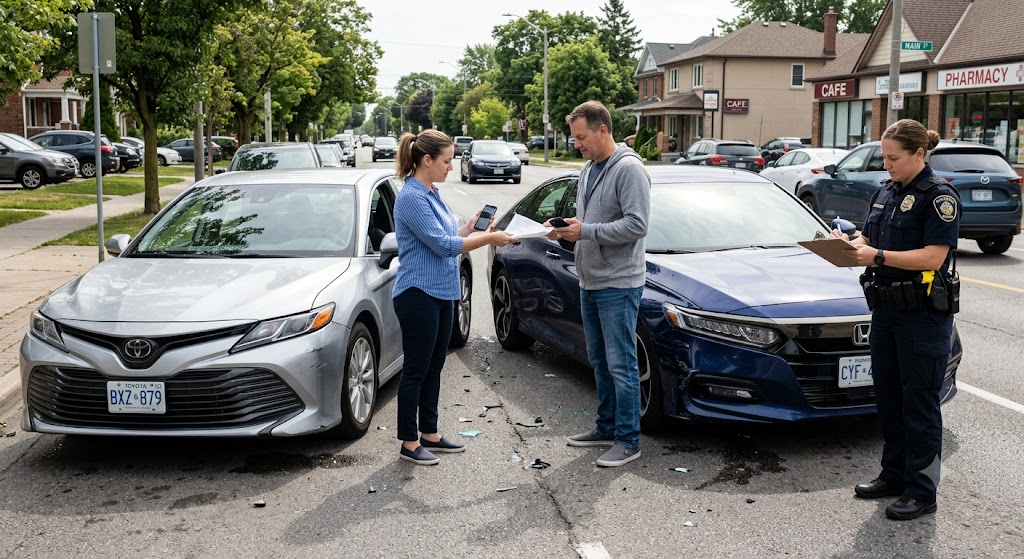
There are hundreds of vehicle crashes every day on American roadways that leave drivers struggling to prove what actually happened. Navigating the immediate fallout of a collision requires far more than exchanging basic insurance details on the shoulder of the road.
Securing objective, time-sensitive evidence right at the scene often dictates how smoothly an insurance settlement resolves. Capturing precise digital and physical details creates an airtight record before crucial facts vanish or memories fade.
1. Timestamped Photos and Video
Visual documentation provides immediate context that words simply cannot replicate. Capture high-resolution photos of the vehicle positions, street signs, traffic lights, skid marks, and property damage from multiple angles.
Make sure your smartphone camera settings have automatic metadata toggling enabled so every image locks in precise location data.
Taking wide-angle shots helps re-create the broader scene, while close-ups capture structural impact severity accurately.
2. Telematics Speed and Braking
Modern vehicles log extensive operational metrics through internal computers and connected driver applications. Extracting telematics records provides definitive proof of acceleration rates, vehicle velocity, and exact braking inputs prior to impact.
In states like California, these hard metrics eliminate subjective claims about who was speeding or driving recklessly when liability gets contested after a crash. Drivers seeking legal guidance through specialized car accident lawyers in Los Angeles often rely heavily on this onboard telemetry to establish fault and pursue fair financial compensation.
3. GPS Location and Mapping
Precise geographical coordinates validate the exact positioning of each vehicle during the incident. Pulling real-time satellite location logs confirms specific traffic lanes, intersection layouts, and exact direction of travel.
Reviewing this precise spatial positioning, along with ADAS data from onboard systems, provides an undisputed blueprint of the crash sequence. Satellite records also prove useful when disputing inaccurate driver claims regarding lane changes or illegal turns.
4. Witness Contacts and Statements
Neutral third-party observers offer critical, unbiased accounts of how the collision unfolded. Collect full names, phone numbers, email addresses, and brief recorded notes from anyone who stopped to assist or saw the impact happen. Passersby, nearby shopkeepers, and other motorists often notice details that involved drivers missed while reacting to the hazard.
Securing these eyewitness contacts before people leave the area prevents vital testimonies from disappearing permanently.
5. Police Report Number and Officer Details
Official law enforcement documentation carries immense weight with insurance adjusters and legal teams alike. Write down the responding officers names, badge numbers, police department jurisdiction, and the official accident report incident number.
- Request the card of the primary investigating officer before leaving the scene
- Verify that the officer correctly logs all driver license and policy details
- Note the specific law enforcement agency filing the final public record
A clear lead-in ensures all law enforcement details are tracked carefully from the moment responders arrive at the scene.
6. Weather and Lighting Notes
Environmental factors heavily influence visibility, road friction, and total stopping distance. Document local conditions immediately, including active rainfall, fog, standing water, sun glare, or unlit roadway sections.
Taking these factors into account helps determine if a motorist was driving too fast for conditions causes of car accident metrics typically highlight. Dynamic environmental changes mean weather notes must be logged directly at the scene.
7. Medical Symptom Logs
Immediate shock frequently masks acute bodily injury following a high-impact collision. Maintaining a daily physical journal tracks pain levels, emerging soreness, mobility limitations, and medical visits starting immediately post-crash.
Detailed documentation of soft tissue injuries and delayed-onset discomfort proves crucial when linkable to initial post-collision clinical trauma evidence recorded by treating physicians. Consistent medical notes protect your health while connecting injuries directly to the incident.
8. Damage Diagrams and Scene Layouts
Sketching a clear physical diagram grounds all collected digital files into a cohesive narrative. Draw a simple layout showing street names, traffic flow arrows, point of impact, and final rest positions of all involved vehicles.
Adding measurements between skid marks and fixed landmarks adds another layer of mathematical certainty to the file. This structural layout ties your photos, telematics, and notes into one undeniable master summary.
Modern Accident Evidence Standards
Digital evidence transforms how crash claims move through administrative and legal channels. Capturing clear, timestamped data points gives you total control over the narrative of your accident.
Feel free to explore the site for more insightful posts on vehicle tech and car accident data.