
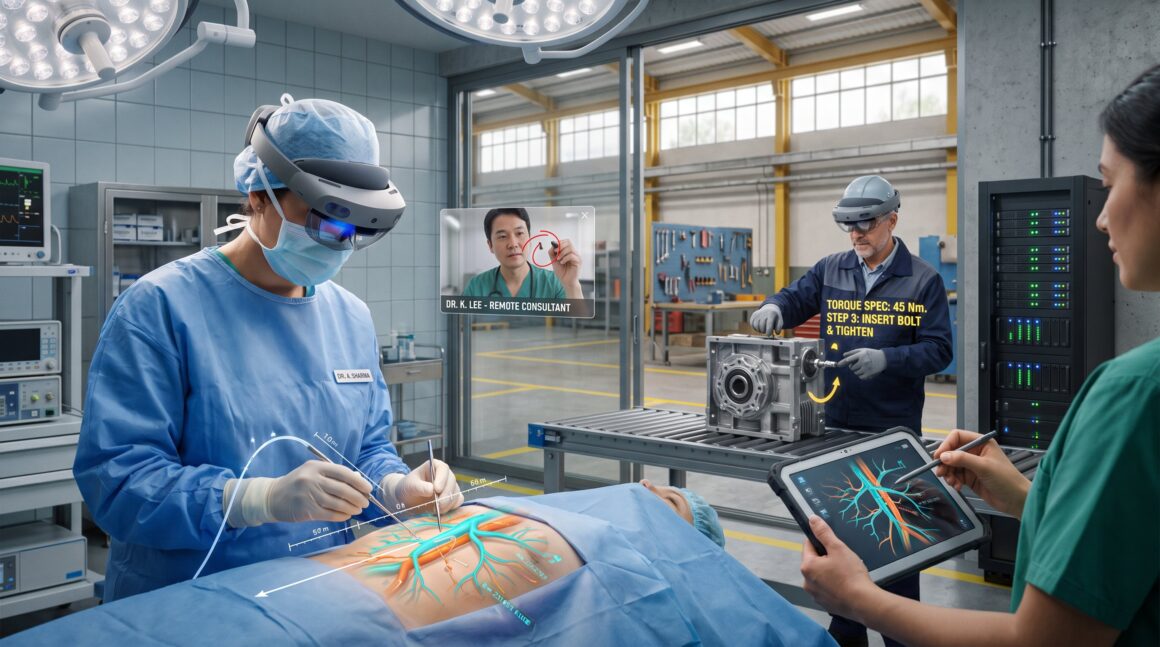
How Augmented Reality Is Moving Beyond Entertainment is no longer a slogan, by 2026 enterprises use AR to cut errors, speed tasks, and lower costs. The shift began when head‑worn displays and phone AR moved from novelty demos to repeatable workflows. This article explains why AR passed the entertainment threshold, shows concrete enterprise use cases in healthcare and industry, details the supporting technologies, and outlines practical design and implementation strategies organizations use to get measurable results.
Key Takeaways
- Augmented Reality (AR) has evolved beyond entertainment, now delivering measurable operational benefits such as error reduction and task acceleration in enterprises.
- Healthcare and manufacturing sectors lead AR adoption by applying precise overlays to improve surgical outcomes and streamline assembly and repair tasks.
- Successful AR deployments rely on technologies like spatial computing, edge AI, and 5G to ensure accuracy, real-time collaboration, and lightweight devices.
- Effective AR design focuses on minimizing cognitive load by presenting only task-critical information with stable, readable visuals to enhance user adoption.
- Organizations overcome AR implementation challenges through tailored hardware choices, AI-assisted content creation, seamless system integration, and pilot programs with clear KPIs.
- Treating AR as a workflow tool rather than a novelty encourages focus on measurable improvements, ensuring enterprise value and scalability.
Why Augmented Reality Is Finally Moving Past Entertainment
Fact: AR shifted from fun demos to business tools because it started to deliver measurable operational gains. Between 2022–2026, pilots that overlayed stepwise instructions or live expert annotations reduced task time and error rates enough that finance teams approved rollouts. The change came from three concrete trends: lighter headsets, affordable edge rendering, and robust spatial mapping. Together they turned holograms from fragile tricks into stable overlays that workers can trust.
Context and evidence: surgeons began trusting AR overlays when navigation accuracy reached sub‑millimeter repeatability: factories accepted AR when guided assembly improved first‑pass yield. Organizations learned hard lessons about distraction and clutter, early deployments failed when interfaces showed too much data. Teams then redesigned displays to only surface task‑critical cues, which improved adoption. This transition explains why AR vendors now pitch productivity and safety instead of spectacle.
Practical takeaway: leaders should treat AR as a workflow technology, not a marketing toy. Pilot with one measurable KPI, time per task or service‑call cost, and instrument it. That discipline separates entertaining demos from enterprise value.
Key Enterprise Use Cases Driving Real-World Adoption
Fact: healthcare and industrial uses dominate current enterprise AR ROI stories. These verticals use AR for accuracy, remote skills transfer, and faster diagnostics.
In practice, teams select one clear problem, like reducing surgical rework or cutting mean time to repair, then map AR overlays to that task. That focus keeps content production manageable and shows concrete savings early. The next two subsections examine how hospitals and factories apply AR, with realistic numbers and lessons learned.
Healthcare: Surgical Guidance, Remote Care, And Patient Education
Fact: AR improves surgical precision and supports remote consultations when integrated with imaging and navigation systems.
Example: a neurosurgery team used AR overlays of MRI slices and instrument trajectories to reduce OR time by 12 minutes on average and decrease repositioning steps per case. That saved roughly 8–10% of procedure time in trials. In remote care, specialists annotate live feeds while a local clinician follows instructions: hospitals reported fewer transfers and quicker diagnosis for complex cases. This is covered in more depth in the pillar overview.
Patient education: AR visualizations of arteries or tumor margins help patients grasp risks and follow‑up care. After introducing 3D overlays in pre‑op consults, one clinic measured a 27% increase in informed consent recall during follow‑up.
Honest warning: integration is not plug‑and‑play. Teams must align AR overlays to imaging coordinate frames and validate accuracy against surgical navigation. Early attempts that skipped validation risked misleading clinicians. Successful deployments involve radiology, OR staff, and IT in parallel, plus clear KPI gates before scaling.
Manufacturing And Field Service: Hands-Free Workflows And Real-Time Diagnostics
Fact: hands‑free AR guides and remote expert annotations reduce service costs and speed repairs.
Concrete example: a field service program paired head‑worn AR with remote experts and reported savings of more than $2,300 per complex service call in initial pilots. On the shop floor, guided assembly overlays reduced errors during small‑parts insertion by 38% and cut onboarding time for new technicians from four weeks to two. Warehouse pilots using AR picking cues improved picks per hour by 15% and reduced misplaced items.
Operational lesson: durable ROI comes from integrating AR with maintenance histories and asset management systems so overlays show the right part and torque spec. Content reusability matters, reusing CAD models for AR saved weeks of asset modeling. Teams also learned to rotate devices to balance battery life and task length: light tasks used AR glasses, longer diagnostics used tablet AR with edge rendering.
Technologies Powering Practical AR: Spatial Computing, Edge AI, And 5G
Fact: reliable AR depends on spatial computing, edge inference, and fast, low‑latency networks.
Spatial computing provides the permanent anchors and digital twins that keep overlays aligned to physical machinery or anatomy. Edge AI performs object recognition and scene understanding locally so the headset overlays the right instructions without cloud roundtrips. Cloud and edge rendering offload heavy graphics, enabling lighter headsets and longer sessions.
Network role: 5G and private wireless deliver sub‑20 ms latency in many deployments, making remote annotations feel immediate and collaborative holograms practical across campuses. That means AR sessions can extend beyond short demos to full procedural support.
Practical note: companies often pair local edge servers with public cloud for heavy model training. This hybrid architecture cuts headset load and keeps sensitive imagery on‑premises. For implementation examples and broader trend context, readers can consult an overview of technology trends on the site’s central guide about emerging tech.
Design Principles For Effective, Nonintrusive AR Experiences
Fact: good AR design minimizes cognitive load and surfaces only what matters now.
Principles that work: contextual relevance (show task‑critical cues only), stable anchoring (no drift or clipping), readable visuals (high contrast, adaptive to lighting), and safety/privacy by design (do not block sightlines: encrypt captured data). Teams that followed these rules saw higher adoption: one manufacturing group reported a 63% faster acceptance after simplifying overlays.
Design practice: prototype with real users on the shop floor or in the OR. Test for ambient light, PPE interference, and how gestures work with gloves. Use progressive disclosure, show a single step, then reveal the next after confirmation. Finally, plan fallback modes: allow a technician to switch from head‑worn AR to a tablet view if the headset battery dies or if the environment is hazardous.
Implementation Challenges And How Organizations Overcome Them
Fact: common barriers are hardware limits, content cost, systems integration, user adoption, and privacy concerns, but each has practical mitigations.
Hardware: battery life and weight improved when teams used edge/cloud rendering and selected devices matched to task length. Content production: generative AI plus reusing CAD models reduced 3D asset cost by a reported 40–60% in some programs. Integration: adopting interoperability frameworks and lightweight APIs simplified connections to ERP and asset databases.
Adoption: organizations overcame resistance through short, measurable pilots with clear KPIs (first‑pass yield, service‑call time). Training combined on‑device micro‑lessons and shadow sessions with experts. Privacy and security were addressed with on‑prem processing, encrypted telemetry, and strict data‑retention policies.
Resources and links: teams scaling AR often follow patterns described in articles about how emerging technology moves from experiment to everyday tools. For selection guidance on endpoint hardware and deployment planning, see a short guide on how to choose a laptop that supports field AR workflows. For a broader technology foundation, the site’s central guide offers an overview of trends and tools.