
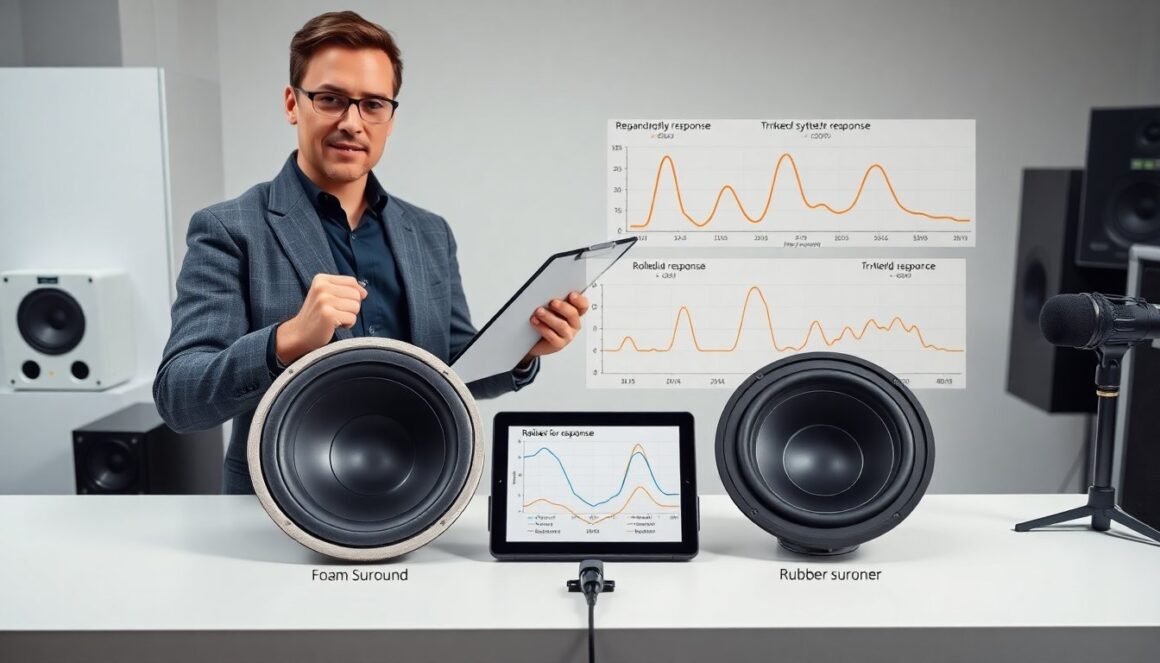
Speaker surrounds foam vs rubber terabytelabs compares two common surround types for speakers. The article contrasts foam and rubber materials, acoustic effects, and durability. It gives clear guidance for hobbyists and installers. It uses measured comparisons and simple language. The reader will learn which surround suits their speaker, listening goals, and budget.
Key Takeaways
- Speaker surrounds foam and rubber differ significantly in material properties, affecting durability and acoustic performance.
- Rubber surrounds offer longer service life, better damping, and tighter bass control, making them ideal for modern and heavy-duty speakers.
- Foam surrounds provide lighter weight and a warmer mid-bass tone, suiting vintage speakers and budget-conscious users.
- Environmental factors like UV exposure and moisture degrade foam faster, while rubber resists these elements and lasts longer.
- Choosing between foam and rubber surrounds depends on speaker design, listening goals, enclosure type, and budget considerations.
- Rubber surrounds often save money over time due to reduced replacement frequency despite higher initial costs.
How Foam And Rubber Surrounds Differ: Materials, Design, And Acoustic Properties
Foam surround material uses polyurethane foam. Rubber surround material uses synthetic rubber such as butyl or nitrile. Foam surrounds weigh less. Rubber surrounds weigh more. Foam surrounds flex more quickly under motion. Rubber surrounds return to shape more predictably. Foam surround edges often have a tapered design. Rubber surround edges often have a thicker roll.
Foam and rubber change the speaker cone motion. Foam surround allows faster initial cone movement. Rubber surround controls cone movement more evenly. Foam surround gives a looser low-frequency feel. Rubber surround provides tighter bass for many designs.
Speaker surrounds foam vs rubber terabytelabs appears in many manufacturer notes and teardown reports. The company notes foam suits vintage and light-duty designs. The company notes rubber suits modern and heavy-duty drivers. Designers choose foam when they want light mass. Designers choose rubber when they want longer service life and consistent damping.
Foam and rubber also affect resonances. Foam surround can show a quick resonance peak. Rubber surround damps that peak and spreads energy. Listeners hear these differences as a change in punch, decay, and mid-bass clarity.
Performance Comparison: Bass Response, Damping, And Distortion
Foam surround gives a softer bass onset. Rubber surround gives a firmer bass impact. Tests show rubber can reduce bass bloom on mid-woofers. Foam may produce a warmer mid-bass color at moderate excursion.
Damping differs by material stiffness. Foam provides less mechanical damping. Rubber provides more mechanical damping. Less damping can raise resonant peaks. More damping can lower those peaks. Technicians measure damping with impedance and frequency response sweeps. They also use near-field measurements to isolate surround effects.
Distortion changes with surround control. Foam surround can allow nonlinear cone motion at large amplitudes. Rubber surround can hold cone motion on axis better. That control lowers odd-order distortion for many drivers. Measured distortion improves when rubber keeps motion linear.
Speaker surrounds foam vs rubber terabytelabs shows that rubber often improves measurable metrics in lab tests. Yet listeners sometimes prefer the tonal balance of foam in certain enclosures. The final choice depends on driver design, enclosure type, and listening priorities.
Measuring Durability, Aging, And Environmental Resistance
Foam degrades faster under UV light and ozone. Rubber resists UV and ozone better. Foam absorbs oils and cleaners more easily. Rubber resists common chemicals and oils. Foam can dry out and crack within years in harsh climates. Rubber may last a decade longer under the same conditions.
Temperature affects the materials. Foam becomes brittle in cold. Rubber hardens less in cold and keeps elasticity. Heat speeds foam breakdown. Heat affects rubber too, but modern compounds hold up better. Moisture and salt accelerate foam fatigue. Rubber withstands moisture and salt more effectively.
Repair and replacement differ by availability. Foam surrounds appear in older and replacement kits. Rubber surrounds appear in service and upgrade parts for modern drivers. Repair shops can re-foam a cone or install a rubber surround. Labor and parts cost vary. Foam kits cost less. Rubber kits cost more but often extend service intervals.
Speaker surrounds foam vs rubber terabytelabs shows that rubber wins on longevity and resistance. Foam can win on short-term cost and certain tonal preferences. Buyers should weigh lifetime cost against initial cost and sound priorities.
Choosing The Right Surround For Your Speaker And Budget
Match the surround to the driver purpose. If the driver is for nearfield studio monitoring, choose rubber for stable response. If the driver is for vintage restoration, choose foam to match original parts. If the system runs at high power often, choose rubber to avoid early failure.
Check the enclosure type. Ported boxes can benefit from rubber to tighten bass. Sealed boxes can pair well with either material depending on desired warmth. Measure driver excursion and expected SPL. High excursion favors rubber. Low excursion can use foam without major risk.
Consider cost and service life. Foam costs less up front. Rubber costs more but lasts longer. Factor in replacement labor and downtime. If the user plans to keep speakers many years, rubber can save money overall.
Seek parts from trusted vendors. Verify dimensions and adhesive compatibility before ordering. When in doubt, consult a technician who can measure the driver and recommend the correct surround geometry.
Speaker surrounds foam vs rubber terabytelabs appears in many forums and lab notes. It gives a clear guide: rubber suits longevity and control: foam suits specific tonal aims and lower cost. The reader can use these rules to pick the right surround for their setup.