
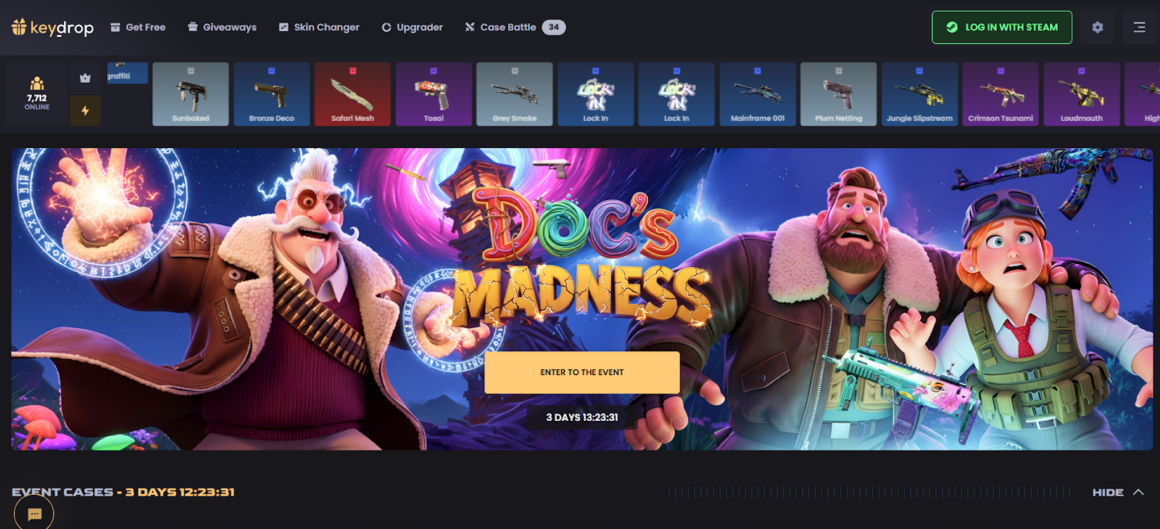
Most people who use gaming platforms are not naïve. They know Keydrop promo codes and bonuses exist to push activity, increase spending, and keep users coming back. This is common knowledge, especially among players who have been around for a while.
And yet, discounts keep working.
People still activate promo codes, still feel a pull when an offer is time-limited, and still change their behavior because of bonuses they fully understand are part of a system. That’s not because users are careless or uninformed. It’s because gaming discounts don’t operate on simple logic. They work on perception, emotion, and timing.
A promo code doesn’t just change a number on a balance. It changes how the entire interaction feels. This article breaks down why that happens and how platforms like KeyDrop design promo codes around very predictable human behavior.
Why Gaming Discounts Feel Different From Regular Discounts
A discount in a normal store is straightforward. You see a product, you see the old price, you see the new price. The math is clear, and the decision usually is too. Either the lower price feels reasonable for what you’re getting, or it doesn’t. If it doesn’t, you walk away and nothing else happens.
Gaming discounts don’t follow that logic at all.
When you activate a promo code on a gaming platform, you’re not paying less for a specific thing. You’re paying to enter a process. You don’t know exactly what you’ll get, how long the interaction will last, or how you’ll feel about it once it’s over. The value isn’t visible at the moment of purchase because the purchase itself is only the starting point.
In other words, you’re not evaluating a product. You’re evaluating a possibility.
That difference matters more than it might seem. In retail, the moment you pay is the moment the transaction is essentially finished. In gaming, paying is the moment the experience begins. Everything that follows — anticipation, interaction, surprise, disappointment, excitement — is part of what you actually bought.
This is why comparing retail discounts and gaming discounts helps clarify why they feel so different.
| Retail discounts | Gaming discounts |
| The product has a fixed value | The outcome is uncertain |
| The benefit is measurable immediately | The value reveals itself over time |
| The purchase ends the interaction | The purchase starts the interaction |
| Emotion plays a minor role | Emotion drives the decision |
In a retail context, emotion might influence whether you like a product, but it rarely affects how you calculate the discount. The value is there on the tag. You don’t need imagination to evaluate it.
In gaming, imagination does a lot of the work. The user fills in the gaps between what’s promised and what might happen. That mental space is where discounts gain their power. A bonus doesn’t have to be large to feel important. It just has to expand what could happen next.
Why Uncertainty Is So Engaging in Gaming
One of the strongest forces behind gaming discounts is uncertainty. Not confusion and not randomness for its own sake, but structured unpredictability that users learn to recognize and expect. Most players understand the rules of the system. What they never fully know is how a specific interaction will end.
That gap between understanding the structure and not knowing the outcome is where attention settles.
In many gaming systems, rewards are not guaranteed. What is guaranteed is the process of finding out. The platform promises a moment of anticipation, a reveal, and a result — whatever that result may be. For many users, that promise alone is enough to keep them engaged longer than they planned.
Anticipation does the emotional work before anything happens
Before a reward appears on the screen, the mind is already active. The moment between initiating an action and seeing the result creates emotional tension. That tension doesn’t depend on how large the reward might be. It depends on uncertainty.
During this short window, users mentally run through possible outcomes. Even though most of those outcomes are unlikely, they all coexist in the mind at the same time. This makes the waiting phase emotionally dense. The experience feels significant before it becomes concrete.
Uncertain rewards distort how people think about probability
When outcomes are predictable, people evaluate them logically. When outcomes are uncertain, that logic weakens. Instead of thinking in averages or likelihoods, users focus on what could happen at its best.
This shift happens automatically and consistently.
- The highest possible outcome becomes more vivid than the most likely one.
- Low-probability results receive disproportionate attention.
- The mind treats possibility as more important than probability.
As a result, the potential upside feels closer and more realistic than it actually is, even when the user intellectually understands the odds.
Uncertainty prevents repetition from feeling repetitive
Most gaming interactions are structurally repetitive. The same actions are performed again and again. What prevents this from becoming boring is not variety in behavior, but variety in outcome.
As long as the result is uncertain, repetition is masked.
- The same action feels different each time because the result changes.
- Familiar mechanics don’t trigger boredom as quickly.
- Engagement lasts longer without introducing new content.
Uncertainty acts as a buffer between repetition and fatigue. The user doesn’t experience the interaction as “the same thing again,” even when it objectively is.
The emotional peak happens before the reward, not after
One of the most overlooked aspects of uncertain reward systems is where emotion actually peaks. It’s not at the moment the reward is received. It’s during the moments leading up to it.
The waiting, the animation, the reveal — these are the points of highest emotional intensity. This is why users often remember the feeling of opening or waiting much more clearly than the result itself. The reward fades faster in memory than the anticipation.
The experience is front-loaded emotionally.
Why promo codes amplify this effect without changing the system
Promo codes don’t alter how uncertainty works. They don’t make rewards better or worse. They simply increase access to the process.
By giving users more interactions, an active Keydrop promo code creates more moments of anticipation, more reveals, and more emotional peaks. That increased exposure deepens involvement without needing to change the underlying mechanics.
The appeal isn’t in guaranteeing better outcomes. It’s in allowing the experience of uncertainty to happen more often.
Loss Aversion and Time Pressure
Time pressure doesn’t improve offers. It doesn’t make bonuses more valuable, more generous, or more rational. What it does is shift how people think about them. The same promo code can feel optional without urgency and almost unavoidable once a deadline is attached.
When a promo code has an expiration date, the decision quietly changes shape. Instead of asking whether the bonus is actually worth using, the user starts asking whether they’re comfortable letting it expire. The focus moves away from value and toward loss.
That shift alone is enough to change behavior.
How urgency reframes the decision
Without time pressure, users have space to reflect. They can compare options, postpone the decision, or decide not to engage at all. Once urgency is introduced, reflection feels risky.
The decision becomes emotionally framed around avoidance rather than preference.
- Acting now feels like securing an option.
- Waiting feels like giving something up.
- Inaction is interpreted as a loss, not a neutral choice.
This reframing happens quickly and often without conscious awareness.
Why limited-time codes reduce hesitation
Limited-time promo codes shorten the gap between intention and action. When time is abundant, hesitation is easy. When time is scarce, hesitation feels dangerous.
The presence of a deadline changes how hesitation is interpreted.
- Pausing feels like wasting an opportunity.
- Reconsidering feels like overthinking.
- Immediate action feels efficient and decisive.
As a result, users are more likely to move forward even if they would normally take more time to evaluate the offer.
Why seasonal and event-based bonuses feel harder to ignore
When bonuses are tied to events, they gain emotional context. They stop being standalone offers and become part of a moment.
Seasonal and event-based promotions carry an implied narrative.
- The offer feels unique to a specific time.
- Missing it feels like missing part of the experience.
- The bonus becomes associated with memory rather than value.
Because events are temporary by definition, users are less inclined to delay. The bonus feels relevant now, not later.
How short activation windows discourage second thoughts
Short activation windows compress decision-making. There isn’t enough time to fully evaluate, so the brain switches strategies. Instead of analyzing the offer, users rely on instinct and prior experience.
This change in strategy favors action.
- Familiar platforms feel safer under pressure.
- Past positive experiences outweigh present uncertainty.
- Immediate engagement feels less risky than missing out.
Second thoughts require time. When time is removed, second thoughts rarely form.
Why acting fast feels safer than waiting
Under time pressure, the emotional cost of waiting increases. People imagine regret more vividly than they imagine wasted effort. Acting quickly feels like closing a loop, while waiting feels like leaving something unresolved.
Even when the actual benefit is small, the emotional relief of acting can outweigh rational concerns.
That’s why urgency doesn’t need to exaggerate value. It only needs to make inaction uncomfortable.
Why Using a Promo Code Feels Like Making a Smart Decision
There’s a subtle but powerful difference between spending money directly and spending money after entering a promo code. On the surface, the amount you pay might be the same or even negligible. But psychologically, the experience is completely different. Using a code turns a simple transaction into a sequence of choices, giving the impression that the decision is deliberate, thoughtful, and controlled.
It’s one of the reasons promo codes are so effective. They make people feel like they are acting strategically, even when the outcome is mostly determined by chance.
How activating a promo code creates a sense of involvement
When a user enters a promo code, the action is no longer instantaneous. It requires a few steps: selecting the code, applying it, deciding how to use the bonus, and watching the system respond. Each of these steps introduces a moment of mental engagement. That sequence turns a passive transaction into an active one. The player feels like they are participating in shaping the outcome rather than just receiving it.
This sense of participation changes perception in several ways:
- It makes the decision feel intentional.
- It reframes spending as a calculated move.
- It increases ownership of the result, whether it’s a win or a loss.
The same action feels very different with and without a promo code
The psychological contrast is clear. When people spend without a code, it often feels spontaneous. They click, pay, and move on. There’s little reflection, and even less sense of strategy.
When a promo code is involved, the interaction feels planned and deliberate. It’s almost like performing a small ritual before the reward. That extra layer of engagement creates a perception of competence and intentionality, making the choice easier to accept and the outcome easier to enjoy.
| Without a promo code | With a promo code |
| Feels spontaneous | Feels planned |
| Spending feels direct | Spending feels justified |
| Less confidence afterward | More confidence afterward |
Why a sense of control reduces hesitation
Humans naturally resist actions that feel impulsive or unconsidered. That hesitation can delay engagement or even prevent it entirely. Entering a promo code introduces the illusion of control: the user chose, applied, and directed the action. Even if the result is random, that control satisfies the part of the brain that wants to feel competent and rational.
Because of this, users are more likely to:
- Commit to a transaction quickly
- Feel positive about the decision afterward
- Re-engage with the platform more readily
Why Seeing Other People Use Promo Codes Matters
Gaming almost never happens in a vacuum. Even when you’re playing alone, your behavior is influenced by the people you watch, the communities you follow, and the discussions you read online. Promo codes don’t exist in isolation either—they circulate through these social spaces, and that circulation has a powerful effect on how players perceive them.
When a code is mentioned repeatedly, it stops feeling like a marketing tactic. Instead, it starts feeling like shared knowledge—something that other players use, trust, and rely on. This is a form of social validation, and it can be just as persuasive as any other incentive.
How social validation influences decision-making
Humans naturally look to others when making decisions in situations with uncertainty. If someone else has already tested the system, seen the results, and deemed it worthwhile, that reduces perceived risk. Promo codes work in part because they are easily observed and discussed in public spaces, which gives players a sense of confirmation before they even try it themselves.
Common sources of social proof for promo codes
Social validation for gaming discounts comes from several consistent channels. Each one reinforces the idea that using a promo code is normal, safe, and even expected:
- Streamers using promo codes openly during gameplay. Watching someone demonstrate the code in action removes doubt and shows the process is legitimate. Players see it in real time and understand exactly how it works.
- Community posts confirming that a code works. Forums, Discord servers, and Reddit threads are filled with users reporting success, tips, and timing advice. Reading these posts makes the action feel tested rather than experimental.
- Repeated mentions across multiple platforms and discussions. When the same code appears in different contexts, it signals reliability and trustworthiness. Repetition normalizes behavior and makes it feel routine rather than optional.
Why normalization reduces perceived risk
Once a behavior is normalized, it no longer carries the same uncertainty. Using a promo code stops being a spontaneous experiment and becomes a routine step in gameplay. The more people see others doing it, the less the action feels risky, the less hesitation there is, and the more likely players are to act quickly.
Normalization also creates an indirect sense of urgency. If everyone seems to be using a code, a player may feel compelled to act—not because the code itself is extraordinary, but because social dynamics suggest that inaction is unusual or even disadvantageous.
The psychology behind observing others
Watching others succeed or participate triggers multiple psychological effects:
- Social learning: Users mimic observed behavior when the outcome seems positive.
- Trust by association: If a trusted streamer or community member uses a code, that trust transfers to the action.
- Fear of missing out: Seeing a pattern of engagement by others creates subtle pressure to participate.
Discounts as Design, Not a Gift
Gaming discounts are not generosity. They are design choices built around how people think, feel, and react under uncertainty.
Their effectiveness has less to do with numbers and more to do with timing, presentation, and emotional framing. When users understand that, the dynamic changes. They stop reacting automatically and start engaging intentionally.
That shift doesn’t ruin the experience. It makes it more controlled, more predictable, and ultimately more comfortable for anyone who spends time on gaming platforms.
Conclusion
Gaming discounts don’t rely on users being unaware. They rely on users being human. Knowing how promo codes work doesn’t cancel their effect, because they are designed around attention, anticipation, and emotional timing rather than deception.
Once you see the system clearly, your role inside it changes. You start noticing when urgency is doing the heavy lifting. You recognize when a bonus is extending an experience rather than improving its value. You become more conscious of the moment when excitement turns into pressure.
That awareness doesn’t mean disengaging. It means interacting on your own terms. Promo codes stop being a trigger and start being a choice. The platform still offers incentives, but the final decision feels deliberate rather than reactive.
