
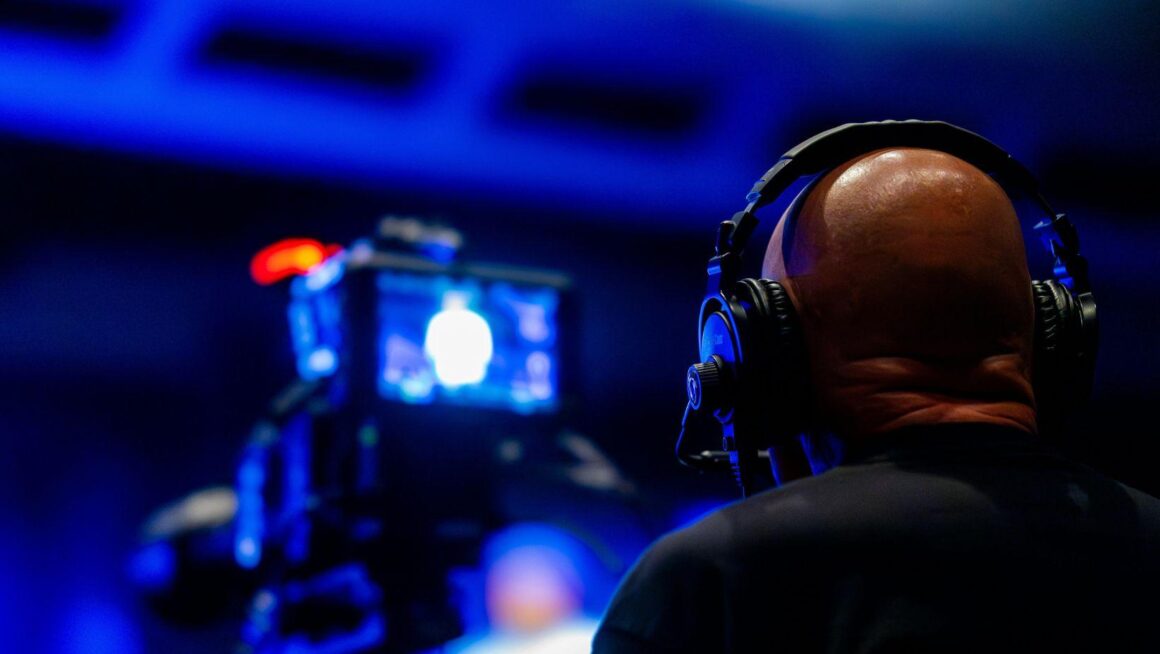
What is REMI (Remote Integration Model) production? Basically, it is a live-event workflow where cameras, audio, and so on remain at the venue while the director, graphics team, and technical controllers operate from a remote production hub.
For enterprise events, that structure allows broadcast-level execution without moving an entire control room onto the show floor. Companies hosting leadership summits, investor updates, or large hybrid conferences are increasingly exploring this model.
How On-Site AV Services Connect to REMI Production
Many enterprise events rely on local production teams, such as AV labor in Las Vegas, to manage things like staging, lighting, and sound systems. They are crucial to successful events.
That on-site layer is still essential with REMI production. The difference is that once cameras and microphones are capturing clean signals at the venue, those feeds can be transmitted to a remote control room where switching, graphics, and live-stream management take place.
What Happens Inside a REMI Production Workflow
In a traditional setup, the director, technical director, graphics operator, and replay team all work from a mobile truck or temporary control room parked outside the venue. REMI production relocates those roles to a centralized facility.
Video feeds travel over dedicated, high-bandwidth IP connections to that facility. From there, the remote team cuts between cameras, inserts branded graphics, rolls pre-produced content, and manages distribution to streaming platforms.
Remote production enables teams to be geographically distributed while reducing operational costs. For enterprise planners running multiple events each year, fewer flights and hotel blocks can translate into meaningful budget flexibility.
Why Enterprise Teams Are Choosing REMI Production
Corporate audiences expect more than a static livestream. They expect dynamic visuals, seamless transitions, remote presenter integration, and on-demand playback that feels intentional rather than improvised.
According to Allied Market Research, demand for live streaming and multi-camera production continues to drive growth in the corporate event AV production market. If your event includes global teams or investor audiences, production expectations rise quickly.
As mentioned, REMI production allows organizations to centralize experienced broadcast professionals in one location while deploying smaller capture teams at each venue. So, that structure supports consistency across roadshows, annual meetings, and recurring town halls.
Budget and Scalability Benefits
Enterprise events often follow repeatable formats. Quarterly updates, leadership broadcasts, and product launches share similar run-of-show structures.
With REMI production, organizations can:
Smaller backstage teams also simplify coordination with venue management and union labor requirements.
Technical Considerations Behind REMI Production
Reliable connectivity drives everything in a REMI workflow. Dedicated fiber lines, bonded cellular backups, and redundant transmission paths are typically part of the production plan.
There is continued growth in conferencing, collaboration, and content capture technologies within corporate environments. As enterprises invest in stronger network infrastructure, the technical conditions that support REMI production become more common.
Planning also includes latency testing, failover protocols, and signal encryption. Rehearsals focus not only on presenter timing but also on network stability.
When REMI Production Makes Strategic Sense
REMI production works particularly well for structured, repeatable formats. Leadership addresses, internal summits, earnings calls, and hybrid conferences can all benefit from centralized control and consistent execution.
Events with unpredictable staging, complex scenic automation, or limited connectivity may still lean toward fully on-site control rooms. Each enterprise must evaluate venue infrastructure, bandwidth reliability, and risk tolerance before selecting a workflow.
For many organizations, REMI production is no longer experimental. It has become part of the standard planning conversation for enterprise events.
Rethinking Enterprise Event Execution With REMI Production
REMI production reshapes how enterprise events are staffed and structured without changing what audiences see and hear. Clean audio, dynamic camera cuts, and professional graphics still define the experience.
The difference lies in crew distribution and infrastructure planning. When strong on-site AV support is paired with a coordinated remote control room, enterprise events can achieve broadcast-level results with greater flexibility.
If your organization is preparing for an upcoming summit or hybrid broadcast, reviewing connectivity, staffing models, and long-term event strategy will help determine whether REMI production aligns with your goals.
Thoughtful planning ensures your enterprise events remain polished, reliable, and ready for both in-person and remote audiences.
Has this post been helpful? If yes, check out some of our other informative articles!